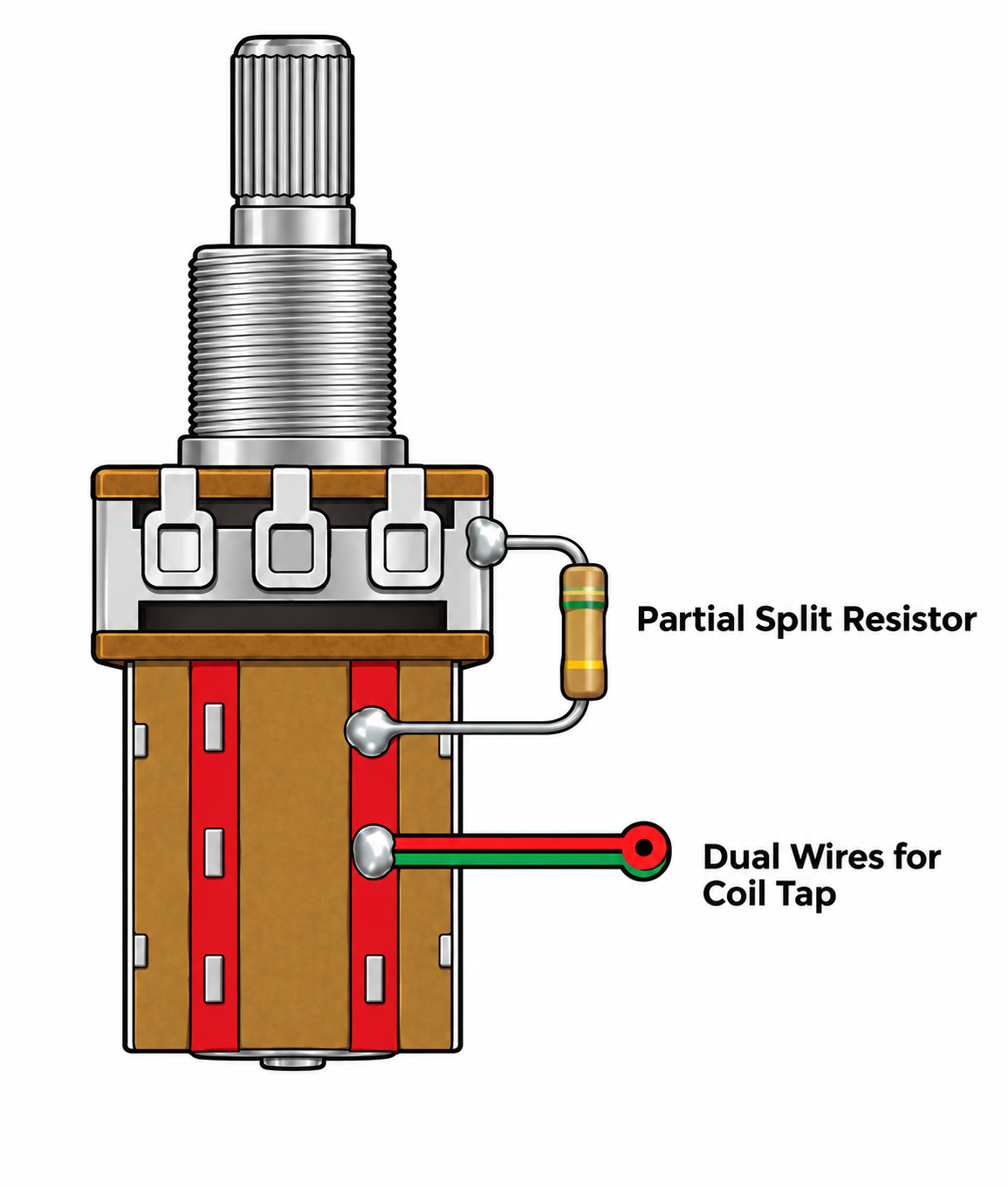
Partial Coil Split: How a Resistor Changes Your Humbucker
A humbucker measuring 14kΩ typically has two coils of approximately 7kΩ each.
With a traditional coil split, one coil is completely bypassed, leaving only the other 7kΩ coil active. This creates a brighter, more single-coil-like sound, but can also cause a noticeable drop in output.
A partial coil split gives us more control.
Instead of completely bypassing the second coil, we place a resistor across it.
How Does It Work?
When a resistor is connected in parallel with the coil, we calculate the combined resistance using:
R = (R₁ × R₂) / (R₁ + R₂)
For example, with a 7kΩ coil and a 7kΩ resistor:
R = (7 × 7) / (7 + 7)
R = 49 / 14
R = 3.5kΩ
The first coil remains at 7kΩ, so the approximate total pickup resistance becomes:
7kΩ + 3.5kΩ = 10.5kΩ
This gives us a middle ground between a full humbucker and a traditional full coil split.
Fine-Tuning With Different Resistors
The resistor value can be changed to control how much of the second coil remains in the circuit, allowing us to fine-tune the character of the split sound.
At Fret & Grain, we stock:
3.3kΩ · 4.7kΩ · 6.2kΩ · 7kΩ · 8.2kΩ · 10kΩ
Different resistor values can produce different levels of output, body, brightness and warmth, giving us more control over the final tone.
| Resistor | Effective Split | Tonal Result |
|---|---|---|
| **3.3kΩ** | More coil bypassed | Brightest, leanest, closest to a conventional split |
| **4.7kΩ** | Moderate bypass    | Bright and clear, with slightly more body |
| **6.2kΩ** | Less bypass           | Fuller, warmer, more output |
| **7kΩ**    | Less bypass           | Balanced compromise between split and humbucker |
| **8.2kΩ** | More coil retained  | Thick, powerful, closer to full humbucker |
| **10kΩ**  | Most coil retained   | Highest output, fullest and darkest of these options |
Full Humbucker → Partial Split → Full Coil Split
A small resistor can make a surprisingly big difference to how a split humbucker sounds and responds.