TREBLE BLEED MODIFICATION
Keeping Your Tone When You Turn Down
A guitar’s volume control does more than simply make the guitar louder or quieter.
As you reduce the volume, the interaction between the guitar’s pickups, volume pot, cable and amplifier can cause some of the high frequencies to be lost. The result can be a darker, less open tone, particularly when the volume control is rolled back significantly.
A Treble Bleed circuit is a simple modification designed to help retain those high frequencies as the guitar’s volume is reduced.
HOW DOES IT WORK?
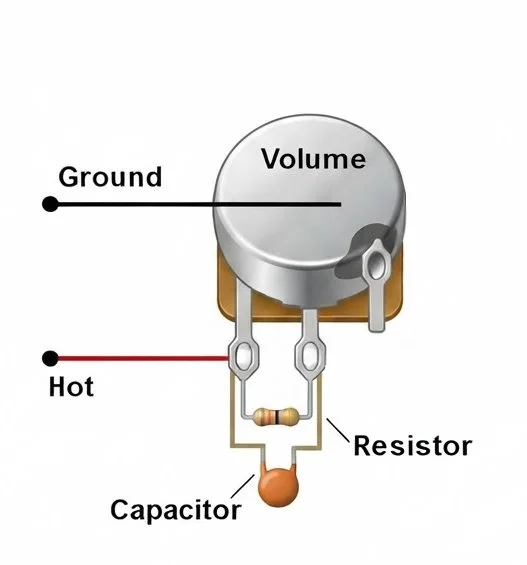
A treble bleed circuit is connected between the input and output lugs of the volume potentiometer.
When the volume control is turned down, the capacitor provides a path for higher frequencies to pass around part of the volume control. This helps preserve clarity and brightness while reducing the overall volume.
The resistor can be added alongside the capacitor to control how the circuit behaves, helping prevent the sound from becoming excessively bright or unnatural.
The important point is that a treble bleed does not increase the guitar’s treble. It is intended to compensate for high-frequency loss that can occur when the volume is reduced.
CAPACITOR + RESISTOR
Different combinations produce different results.
0.001µF + 150kΩ
A relatively controlled treble bleed that can work well when you want to retain clarity without making the guitar noticeably brighter. A useful option for many single-coil guitars.
0.001µF + 220kΩ
Allows a slightly different balance between high-frequency retention and volume taper. This can be particularly useful when a little more clarity is desired, including on some humbucker-equipped guitars.
There is no single "correct" treble bleed value.
The ideal combination depends on the pickup output, pickup inductance, volume pot value, guitar wiring, cable capacitance and, importantly, how the volume control is actually used.
WHY DOES IT MATTER?
A well-chosen treble bleed can make the guitar’s volume control much more useful.
Instead of:
10 → full tone
7 → darker
5 → muddy
you can achieve a more consistent character as the volume is rolled back:
10 → full output
7 → slightly lower output, similar clarity
5 → cleaner and quieter, while retaining definition
This can be especially useful for players who control their gain and dynamics directly from the guitar’s volume knob.
IS TREBLE BLEED FOR EVERY GUITAR?
Not necessarily.
Some guitars already have a volume response that feels excellent without any modification. In other guitars, a treble bleed can make the volume control feel much more responsive and usable.
An incorrectly chosen value, however, can produce an undesirable result, such as excessive brightness, an unnatural volume taper or a tone that does not feel consistent across the volume range.
That is why we look at the complete circuit, rather than simply installing a standard capacitor and resistor.
AT FRET & GRAIN
At Fret & Grain, electronics modifications are approached as part of the guitar’s complete signal path.
We consider the pickups, potentiometer values, existing wiring and the way the instrument is actually played before selecting component values.
The goal is not simply to add a treble bleed.
The goal is to make the volume control work better for the player.